Partner Articles
- All
- RollerAds
- Adsterra
- Epom
- ClickDealer
- Monetag
- Mondiad
- Kinsta
- HilltopAds
- Clickadu
- PubFuture
- BigSpy
- Venatus
- 152 Media
- Refinery89
- YieldMonk
- MyBid
- Profit Ninja
- Epom Market
- Sanebox
- Sevio
- Blockchain-Ads
Search through our collection of over 5,000+ digital solutions, hosting platforms, exclusive deals, and more.


2.5k trusted digital are using our platform












 Affiliate Marketing
Media buyers don't pick CPA networks the way content affiliates do. When you're spending $500–$50,000 a day on traffic, tracking accuracy beats offer variety, cash flow beats peak payouts, and a responsive AM beats a flashy dashboard. A network that scrubs 30% of your conversions or holds your payout for 45 days can turn a profitable campaign into a write-off overnight. This guide ranks the 7 best CPA affiliate networks for media buyers in 2026 — selected on the metrics that actually matter when you're running paid traffic: S2S postback reliability, payment frequency, direct-advertiser offer access, traffic-source flexibility, and AM quality. We've cut the beginner-friendly networks and the "easy approval, low minimum" angle. This list is for affiliates who already have traffic and are looking for the right partner to scale.
 Affiliate Marketing
The global affiliate marketing industry crossed $20 billion in 2023 and is on track to nearly double by 2031, and CPA (Cost Per Action) is one of the fastest entry points into that pie. You don't need to make a sale — you just need someone to fill out a form, install an app, or sign up for a trial. But here's the catch most new affiliates run into: the biggest, highest-paying networks aren't beginner-friendly. They want monthly volume commitments, in-depth phone interviews, and a traffic history you don't have yet. Pick the wrong network as your first one and you'll spend three weeks fighting approval queues instead of testing offers. This guide ranks the 7 best CPA affiliate networks for beginners in 2026 — based on approval difficulty, minimum payout thresholds, payment speed, offer variety, and the quality of training they offer new affiliates.
 Affiliate Marketing
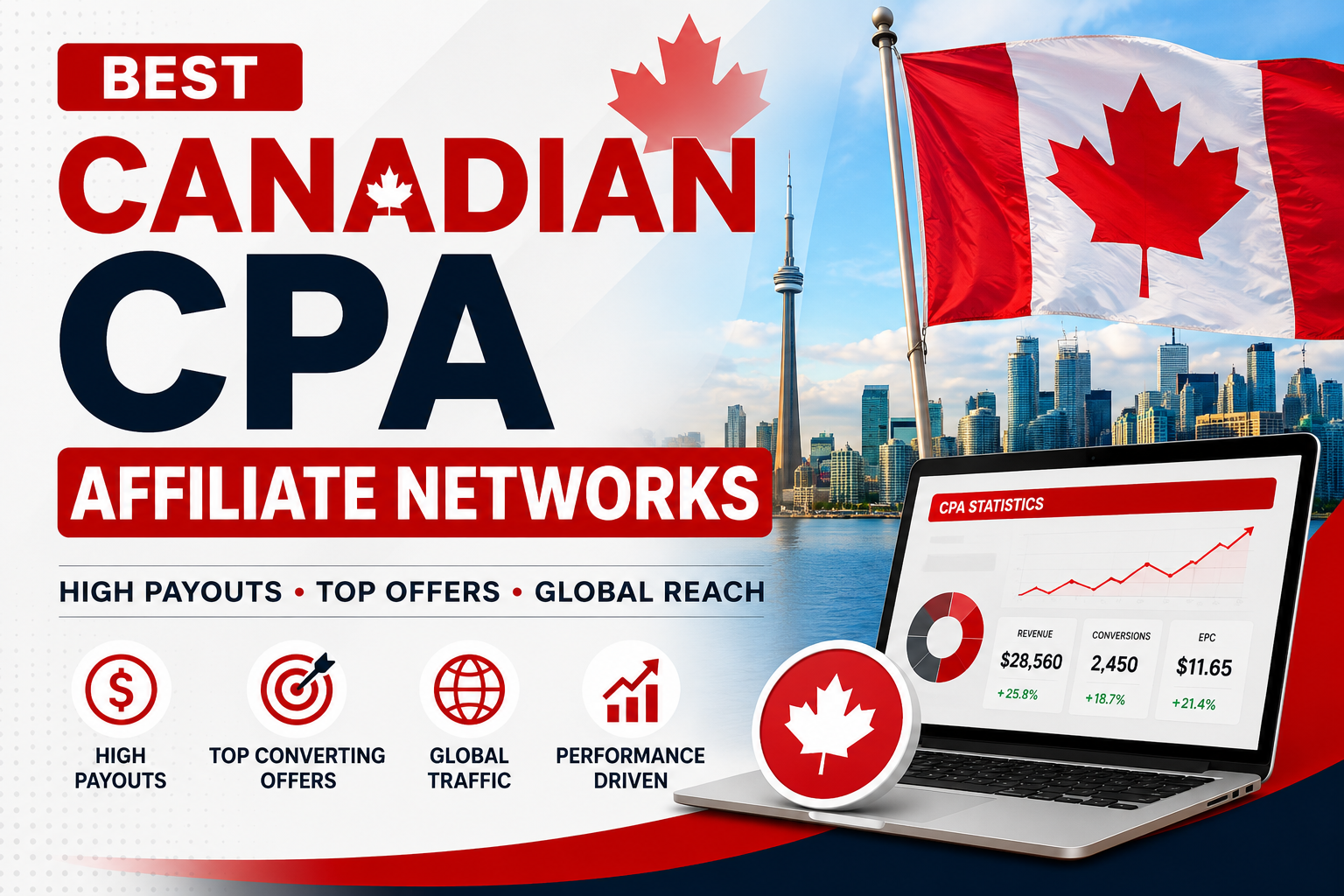
Canada has a unique position in the global affiliate marketing landscape that most "best CPA networks" articles overlook: it's a Tier-1 buyer market with high purchasing power AND home to two of the world's most respected CPA networks — MaxBounty (Ottawa, since 2004) and CrakRevenue (Quebec City, since 2010). Few countries can claim homegrown world-class affiliate networks, and Canadian affiliates benefit from that proximity. But Canada also has distinct structural opportunities that compound affiliate earnings: Cross-border access — Canadian affiliates can serve both the 41M Canadian market AND the 340M US market from a single base, with no language or cultural barriers Bilingual advantage — 8.6M French speakers in Quebec form an underserved market; French-language content has significantly less competition Strong domestic e-commerce ecosystem — Amazon.ca, Shopify (Ottawa-HQ), Indigo, Best Buy Canada, Wayfair Canada, Canadian Tire, Hudson's Bay all run robust affiliate programs Regulated provincial iGaming — Ontario legalized regulated online gambling in April 2022 under iGaming Ontario/AGCO; other provinces operate licensed provincial lotteries Canada also has strict regulatory considerations that affiliates must understand: CRA (Canada Revenue Agency) treats affiliate income as business income subject to federal + provincial tax PIPEDA (Personal Information Protection and Electronic Documents Act) governs privacy federally CASL (Canadian Anti-Spam Legislation) is among the world's strictest email/electronic marketing laws Quebec's Law 25 (replacing the Act respecting the protection of personal information) is stricter than PIPEDA FINTRAC oversees crypto-related promotion GST/HST registration mandatory at CAD $30,000 in revenue This guide ranks the 7 best CPA affiliate networks in Canada in 2026 across three audiences: Canadian content creators and influencers monetizing domestic traffic with Amazon.ca, Shopify, Indigo, Best Buy Canada Canadian media buyers running paid traffic to global and Canadian Tier-1 offers Canadian affiliates taking advantage of the cross-border US-Canada market with international networks Each network's "best for" makes clear which audience it serves.
 Affiliate Marketing
The online dating industry is projected to surpass $11 billion in global value in 2026, and adult dating continues to deliver some of the highest EPCs in affiliate marketing — often 2–3× the payouts of mainstream offers in the same GEOs. But the difference between a profitable campaign and a budget-burner usually comes down to one decision: which CPA network you choose. This guide breaks down the 7 best adult dating CPA affiliate networks in 2026, with verified payment terms, supported GEOs, traffic policies, and the kind of affiliate each one is built for. Whether you're running push, native, popunders, SEO, or social, there's a network here that fits. If you are someone who is transitioning to CPA affiliate marketing and looking to deep dive into the adult niche, this article can be a great starting point for you.
 Website Monetization
If you’re trying to monetize mixed or global traffic, CPA smart link affiliate networks can help you earn more than static affiliate offers by automatically routing visitors to the highest-converting offers based on GEO, device, OS, and behavior.For most publishers, Zeydoo and Mobidea are among the strongest starting points because of optimization engines, beginner-friendly onboarding, and wide GEO coverage. Affiliate monetization has changed. Static affiliate links are no longer enough. If your audience comes from multiple countries, devices, and traffic channels, manually matching offers becomes inefficient fast. That’s exactly where CPA smart link affiliate networks become powerful. Instead of promoting one fixed offer, smart links automatically redirect each visitor to the offer most likely to convert based on multiple variables like country, device, operating system, and even carrier. This creates better monetization efficiency. For publishers, bloggers, and affiliate marketers, that means: Higher EPC Better conversion rates Less optimization work Better monetization of remnant traffic According to leading CPA networks, smart link routing can significantly improve traffic monetization because the system constantly rotates and optimizes offers dynamically. If you want better smart link monetization in 2026, this guide breaks down the 7 best networks worth testing.
 Website Monetization
E-commerce traffic is everywhere in 2026—but converting traffic is another story. For e-commerce brands, the challenge isn’t finding traffic. It’s finding traffic that converts consistently without destroying margins. Some channels are built for immediate purchase intent. Others are better for nurturing awareness before conversion. The smartest brands aren’t relying on just one source—they’re building layered acquisition strategies that combine paid traffic, owned audiences, search visibility, and social commerce. Here are the 7 traffic sources delivering the strongest e-commerce conversions in 2026.
Our publishers are excited to share their experience with you!
The team at Publishergrowth reviewed my site and recommended the ad networks, which helped me double my overall website revenue. Also, the approvals were a breeze. I am particularly excited about their 'sponsored posts' solution since that will be an added revenue for my website.

Beamingnotes.com
I was looking for additional monetization options for my website. With my limited knowledge, I was unable to make the right selections. After I signed up at Publishergrowth, the team performed a site audit and recommended me some ad networks. My overall revenue grew by 44%.

Poemgyan.com
If you have used a product for a long term, you are in a much better position to review it and compare it with others. There are networks that do shady affairs, and thus it becomes very important for publishers like us to know more about ad platforms, tools, and services before working with them.
-1668044393.jpeg)
Blognife.com











 (1).webp)